
Blog OleProf
Varieties of terrace boards: advantages, disadvantages, care and cleaning tips. Terrace decor ideas, design trends and color solutions for a cozy atmosphere. Projects with your own hands, comparison with alternative materials and their advantages.
Light or Dark Deck Board Colors: An Honest Comparison
The color of a terrace affects more than just the appearance of a home. It determines how much the surface heats up in the sun, how visible dust and marks are, and how the space is visually perceived. There is no one-size-fits-all shade. The criteria will differ for an open-air deck in Odessa and a shaded balcony in Lviv.
When making your selection, you should consider the lighting conditions, the intended use of the space, the building’s architecture, and the characteristics of the specific material. If you need a durable floor for a terrace, you should evaluate the color in conjunction with the board’s construction, taking into account the quality of installation and the operating conditions.
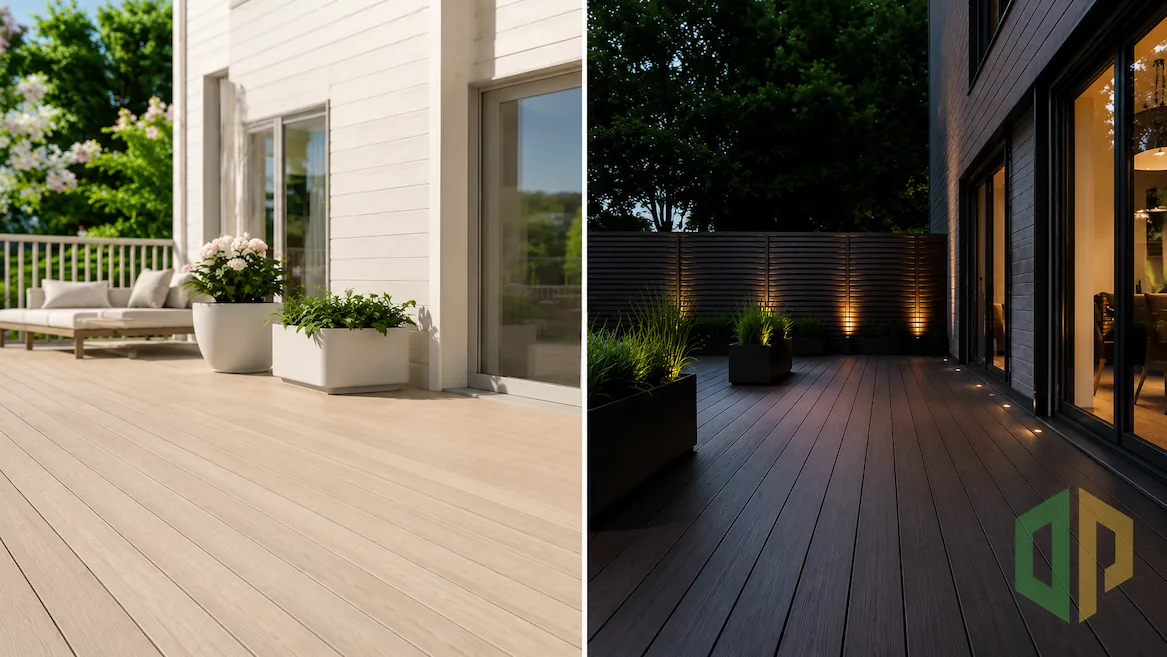
What are the practical differences between light and dark decking?
Light-colored decking tends to get less hot and makes the space feel more open, while dark decking creates a striking contrast but absorbs more of the sun’s heat. The differences are especially noticeable on open, south-facing terraces without a canopy.
Dark shades of decking boards, including Anthracite, Wenge, Chocolate, and Graphite, are well-suited for modern architecture and minimalist facades. Light dust, dried water droplets, sand, and salt stains may be visible on them. However, individual dark stains tend to blend in visually.
Light-colored decking, such as “Natural Wood” or soft brown tones, contrasts less with sand and road dust. However, dirt, grease stains, leaves, and residue from rain are more noticeable on these surfaces.
|
Criterion |
Light shades |
Dark shades |
|---|---|---|
|
Heating in the Sun |
Usually lower |
Usually higher |
|
Visibility of Light Dust |
Lower |
Higher |
|
Visibility of the ground and foliage |
Higher |
Lower |
|
Perception of Space |
More spacious and lighter |
More compact and cozier |
|
A contrast with the light-colored facade |
Soft |
Expressive |
|
Care Requirements |
It depends on the type of stain |
It depends on dust and smudges |
Which color of decking boards heats up less?
Under the same conditions, a light-colored board generally heats up less than a dark one because it reflects more sunlight. However, the exact temperature cannot be determined based on the color name alone.
Surface temperature is also affected by the composition of the composite decking, the profile’s structure and thickness, ventilation beneath the decking, the direction of sunlight, and the duration of direct sunlight. Even light-colored decking can become hot at midday if the deck is on the south side and has no awning.
For pool areas, outdoor café patios, or decking where people walk barefoot, it’s a good idea to consider light and medium tones. Light-colored decking for pool areas reduces the risk of excessive heat buildup, but this does not replace testing a sample on-site.
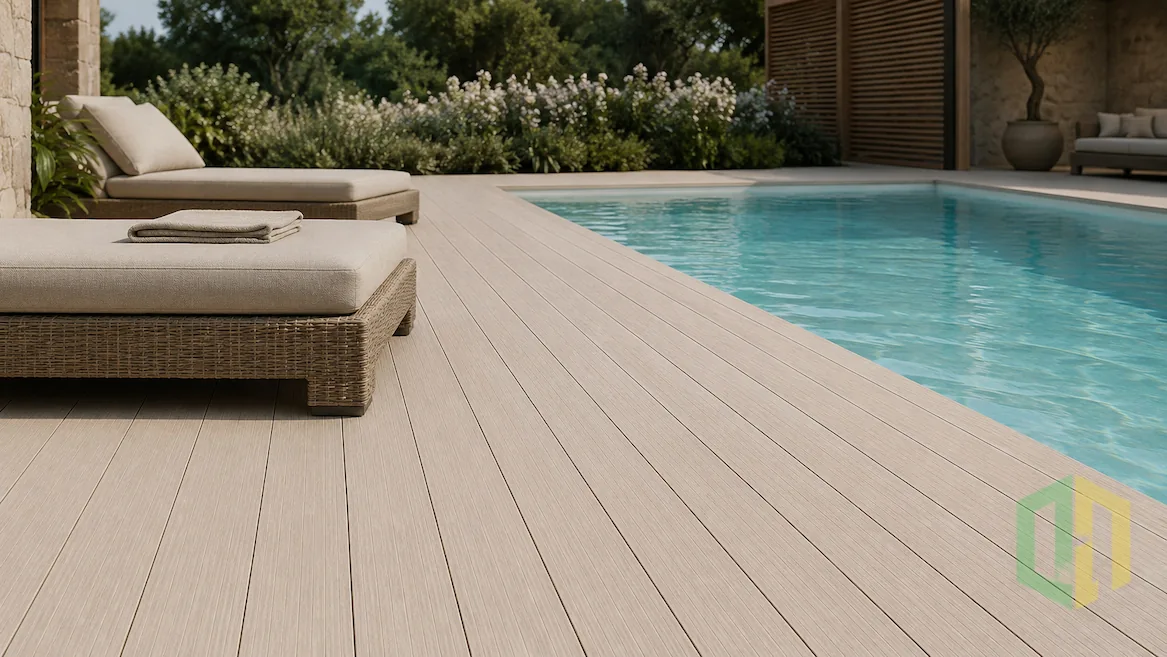
A practical way to choose is to compare several full-size samples. Leave them side by side in the sun for 30–60 minutes, then assess how hot they are by touch and with a non-contact thermometer. It’s best to conduct this test under conditions similar to those at the future installation site.
On which color are marks and stains less noticeable?
Everyday dirt is best concealed by medium, mottled shades with a wood-grain texture. They stand out less against dust, sand, dried-up droplets, and minor shoe marks.
A solid anthracite color may look striking right after cleaning, but light-colored construction dust becomes noticeable on it quickly. On a very light-colored floor, wet soil, fallen leaves, and marks from metal furniture are more visible. A brown wood-grain finish is usually a good compromise.
For cafes, water parks, or high-traffic commercial patios, it’s not just the colors for modern patios that matter, but also the cleaning guidelines. Be sure to check the manufacturer’s recommendations for cleaning products in advance. Abrasives, solvents, and stiff metal brushes can damage the WPC surface.
The texture also matters. Deep embossing hides minor marks, but dirt accumulates more quickly in the grooves. Regularly removing sand reduces abrasive wear and helps keep the flooring looking neat.
Do WPC decking boards fade?
WPC may change color when exposed to sunlight and weather, so any claim of absolute color retention must be supported by technical documentation. The extent of these changes depends on the composite’s formulation, pigments, and protective surface layer.
UV resistance does not mean that the color will remain completely unchanged. During the first few months of use, the shade may stabilize. This is more noticeable with rich, dark colors, since the difference between the original and the altered shade is more pronounced.
Protecting decking boards from UV rays starts with choosing a material designed for outdoor use. You should not varnish or paint WPC without the manufacturer’s explicit permission. The coating may not adhere evenly, alter the board’s slip resistance, and complicate warranty service.
Environmental factors such as moisture, temperature fluctuations, and pollution also play a role. A gradual change in color generally looks more natural than localized discoloration under rugs, potted plants, or furniture. It’s a good idea to move these items around from time to time.
How Color Affects the Perception of a Terrace's Size
Light-colored finishes make the space appear larger, while deep, dark tones make it seem more compact. This effect is particularly noticeable on small balconies, narrow porches, and terraces enclosed by walls.
The extent to which a dark color makes a space appear smaller depends on the surroundings. With good natural light and light-colored walls, Anthracite won’t necessarily look heavy. It can define the boundaries of the flooring and highlight the building’s geometry.
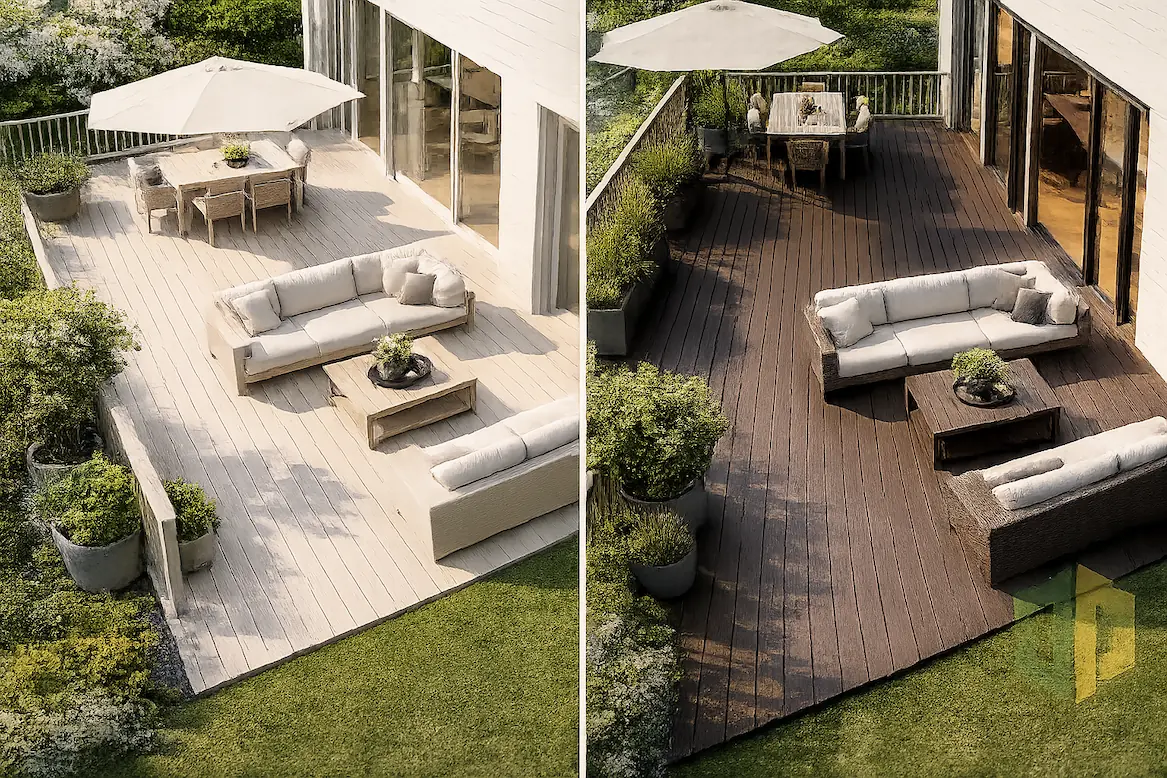
For a small, shaded area, medium or light-colored decking is a safer choice. On a large, open deck, Wenge, Chocolate, and Graphite are acceptable options, especially if the design calls for light-colored furniture, landscaping, and even lighting.
The direction of the installation also affects perception. Longitudinal lines make the area appear longer, while transverse lines make it appear wider. Therefore, it is advisable to consider the color of the deck in conjunction with the installation plan, the width of the boards, and the layout pattern.
How to Match the Color of Your Deck Boards to Your Home's Exterior
It’s best to coordinate the color of the decking not with a single element, but with the overall color scheme of the facade, roof, window frames, and foundation. The shades don’t have to match exactly. More often than not, a difference of a few shades or a well-thought-out contrast looks more harmonious.
The combination of a dark deck with a light-colored facade works well for homes with modern geometric designs. The colors Anthracite and Graphite complement dark window frames, gutters, or roofing. The colors Chocolate, Merbau, and Wenge pair well with brick, stone, and warm-toned stucco.
If the facade’s color scheme is already rich, it’s best to choose a more subdued decking. For a wooden or wood-clad house, you shouldn’t choose decking based on a photo. Similar brown shades may clash in terms of tone: one might appear reddish, while another might look gray or yellow.
The practical combination of decking and the house’s facade is tested using samples under both daytime and evening lighting conditions. A phone screen and catalog prints do not accurately reproduce the color. In addition, the shade changes when placed near greenery, water, concrete, and facade lighting.
How to Choose the Perfect Color for Your Patio
The optimal color should be chosen based on actual growing conditions, the surrounding architecture, and an acceptable maintenance frequency. First, determine the amount of sunlight; then, identify the site’s intended use; and only then compare the shades.
Light and medium-toned options are best for the sunny area around the pool. For a large deck next to a light-colored house, you can use contrasting shades like Anthracite or Graphite. For a family terrace with a garden, Merbau, Natural Wood, and a brown texture are practical choices, as they make everyday dirt less noticeable.
The Oleprof lineup features seven main color options, including Chocolate, Anthracite, Merbau, Wenge, Natural Wood, smoky gray Graphite, and brown wood-grain finishes. You can complement a single shade with WPC siding or picket fencing without overloading the exterior with different materials.
It’s important to consider more than just the aesthetic appeal. Composite decking must be suitable for the expected load, installation conditions, and maintenance requirements. For a commercial project, it’s advisable to specifically coordinate the profile, support spacing, fasteners, and material allowance.
Order samples of Oleprof colors and compare them right next to the facade in both sunny and cloudy weather. Our experts will help you choose the right shade, calculate the amount of decking needed, and coordinate the look of your deck with the facade and WPC fencing.
About us
OleProf - this is a company that provides a full range of services for the terrace: selection, delivery, installation, inspection.
Modern home decor
Oleprof.com ©2026 All rights reserved