
Blog OleProf
Varieties of terrace boards: advantages, disadvantages, care and cleaning tips. Terrace decor ideas, design trends and color solutions for a cozy atmosphere. Projects with your own hands, comparison with alternative materials and their advantages.
Why is the Oleprof hollow-core board stronger than a solid-core board?
Oleprof hollow-core decking boards may outperform some solid-core counterparts in terms of bending strength if their geometry and composite properties provide greater load-bearing capacity. However, this advantage must be confirmed through comparative testing of specific models. The mere presence of air chambers does not make the board any stronger or weaker than any other product.
How stiffeners help a board resist bending
Stiffening ribs connect the top and bottom flanges of the beam, transfer lateral forces, and maintain the profile’s shape. When loaded between joists, the top part of the beam is compressed, while the bottom part is stretched. Therefore, not only the amount of material but also its location relative to the center of the cross-section is important.
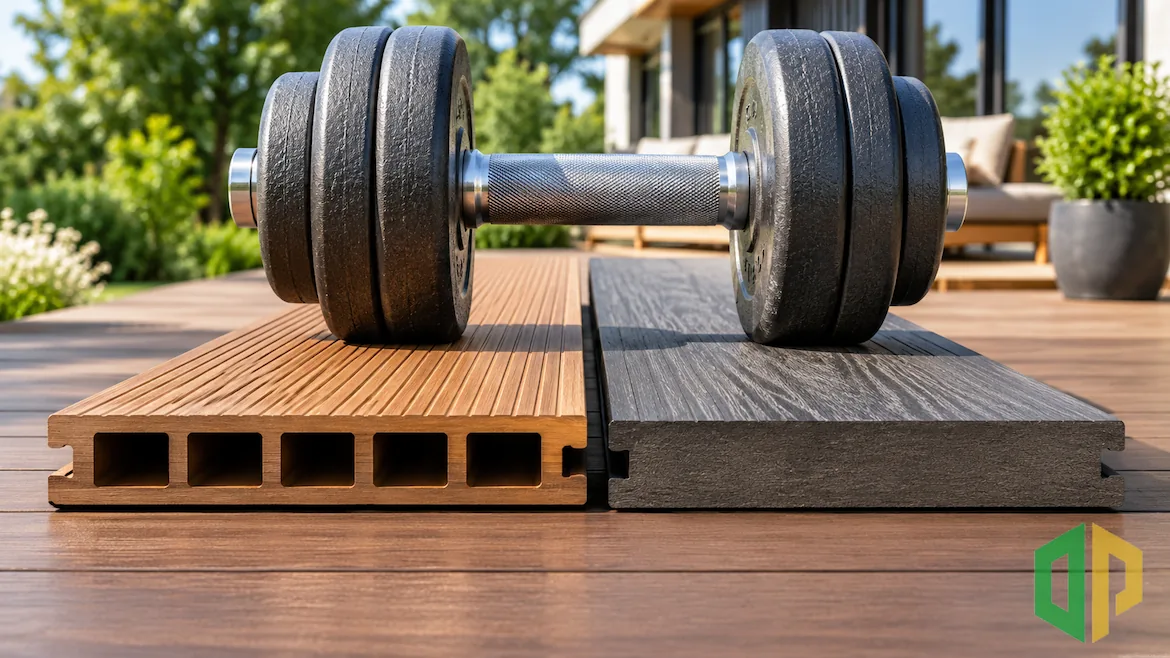
The air chambers in the board do not bear the load themselves. The load is borne by the surrounding walls and cross-braces. Their thickness, height, and spacing are selected in conjunction with one another: a large number of thin ribs does not guarantee a better result than a smaller number of properly calculated ones.
Bending stiffness is determined by the product of two quantities: the material’s modulus of elasticity, E, and the section’s moment of inertia, I. The first characterizes the composite, while the second depends on the geometry. The profile height is particularly important: the material farther from the center of the cross-section resists bending more effectively.
However, stiffness and strength are not the same thing. A small deflection under a person’s weight does not indicate the force at which the board will fail. Both metrics are needed to make a selection.
Which is better: solid or hollow decking boards?
There is no clear-cut winner: solid decking boards and hollow-core decking address the problem in different ways. They should be compared under the same conditions regarding the distance between supports, the load application pattern, and the test conditions.
Given the same material and external dimensions, a solid cross-section has a greater moment of inertia than a hollow one. Removing material does not increase this value. Therefore, the statement “hollows strengthen the board” is technically incorrect.
A hollow WPC may outperform another product if its profile is taller, its walls are arranged more efficiently, and the composite has better mechanical properties. A solid DPC that is thinner or has a less rigid formulation does not gain an advantage simply because it lacks chambers.
A practical advantage of a hollow design is that it allows for a reduction in weight while maintaining the desired performance characteristics. However, low weight alone does not guarantee sufficient load-bearing capacity.
Why a single bending test is not enough
Decking is subjected to various stresses, so high bending strength does not guarantee resistance to impact or pressure from a narrow support. For a deck, it is not a single record-breaking performance metric that matters, but rather how well it performs under real-world conditions.
- Furniture leg. It exerts localized pressure on the top wall, including the area above the chamber. The leg's thickness and the distance between its ribs are important factors here.
- Drop Test. Tests impact resistance. The results of the static load test do not replace the impact test.
- Heavy planter. Under constant load. Creep is a significant factor for DPC: the gradual increase in deformation under a sustained load.
How to Test the Strength of an Oleprof Board
Technical documents and test reports for the selected model provide an objective comparison, not a photograph of the end face or the sample's weight. Ask the supplier to specify the following parameters:
- Profile dimensions: height, width, wall thickness, and web thickness. These help clarify which structures are being compared.
- Test conditions: Distance between supports, temperature, specimen preparation, and method of applying the force.
- Measured results: deflection under a given load and breaking force. These are different characteristics and cannot be used interchangeably.
- Scope of Application. Acceptable installation configurations, load limitations, and warranty terms for residential and commercial properties.
A reference for verifying the methodology: EN 15534-1, a standard for testing composites based on cellulose materials and thermoplastics. What matters is a test report with clear conditions and results, not just a single mention of the standard in an advertisement.
If the test parameters differ, the direct conclusion that “this board is stronger” is incorrect. This is especially true when one manufacturer reports a result for a short span, while another reports a result for a longer span.
How Installation Affects the Durability of the Decking
Even high-quality decking can sag noticeably if the distance between supports is too great. The spacing between joists should be determined according to the instructions for the specific decking profile, taking into account the intended use of the area and the direction of installation.
For a cafe, you cannot automatically apply a layout designed for a home patio. Diagonal installation also changes the actual length of the board span. Joints and edges must be supported as specified in the manufacturer’s installation diagram.
Temperature gaps are necessary to compensate for the linear expansion of the material. Their size depends on the length of the components, the installation temperature, and the product specifications. There is no single value that applies to all WPC boards.
Ventilation and drainage are provided beneath the decking. On the balcony, the permissible load on the slab is checked separately: lightweight decking does not replace an assessment of the load-bearing foundation.
How to Choose Flooring for Your Home or Business
You should choose based on the intended use and verified specifications, rather than on the principle of “the heavier, the better.” If you’re choosing floor covering, first, determine the operating conditions for the flooring.
- Home Terrace: Furniture Arrangement, Heavy Planters, and Spacing Between Supports.
- Cafe or restaurant: foot traffic, pressure from furniture legs, and cleaning routines.
- Pool Area: Slip resistance when wet and compatibility with cleaning products used.
Oleprof decking is available in seven colors. You should choose a shade after reviewing the technical specifications. It is designed for cladding siding board, the following options are available for fencing: WPC picket fence. These products are intended for a different purpose and are not a substitute for flooring.
Before placing an order, ask an Oleprof representative for the technical specifications of the selected decking and installation recommendations. Provide the dimensions of the installation site, a layout of the supports, and the expected loads so that we can discuss a suitable solution.
About us
OleProf - this is a company that provides a full range of services for the terrace: selection, delivery, installation, inspection.
Modern home decor
Oleprof.com ©2026 All rights reserved